
If you are looking for a Clash Royale tier list, the most useful answer is not a permanent list of “good” and “bad” cards. It is a dated snapshot with a clear method, followed by a way to make your own ranking when your deck, mode, or play style tells a different story.
Noff identifies this as a September 2026 snapshot rather than a named game patch. This guide keeps that limitation visible instead of inventing a version number.
dateModified; keep datePublished as the original publication date.This guide uses the Noff Clash Royale tier list as a player-data reference. Noff presents a Meta view based on top-250 player data, with 122 cards grouped from S through F. It is useful for spotting broad trends, but it is not an official Supercell ranking and it can change with balance updates and deck trends.
What this Clash Royale tier list measures
The linked snapshot has six groups: 17 S-tier cards, 17 A-tier cards, 42 B-tier cards, 19 C-tier cards, 15 D-tier cards, and 12 F-tier cards. That distribution is worth noticing. A large B tier does not mean those cards are weak; it separates flexible, broadly useful cards from cards that need a more specific plan.
Clash Royale S/A/B/C/D Tier Snapshot
The source uses S through F. The S/A/B/C/D cards below preserve the source labels and counts; the 12 F-tier cards remain separate below rather than being silently reclassified as D.
S Tier
17 cards · source ranks 1–17Meta-defining reference placements with broad utility, reliable pressure, or strong deck fit.
- Barbarian Barrel
- Skeletons
- Fireball
- Tornado
- The Log
- Zap
- Cannon
- Ice Spirit
- Hog Rider
- Baby Dragon
- Giant Snowball
- Electro Spirit
- Arrows
- Knight
- Elite Barbarians
- Mother Witch
- Freeze
A Tier
17 cards · source ranks 18–34Strong, reliable cards that fit many archetypes but carry more matchup, deck, or timing dependence than S.
- Valkyrie
- Royal Ghost
- Balloon
- Ice Golem
- Inferno Dragon
- Lightning
- Bomber
- Minion Horde
- Goblinstein
- Giant
- Bowler
- Musketeer
- Mortar
- Graveyard
- Berserker
- Battle Ram
- Royal Hogs
B Tier
42 cards · source ranks 35–76Situational cards with real strengths whose value usually depends more on the deck shell, matchup, mode, or execution.
- Princess
- Poison
- Minions
- Skeleton Army
- Electro Wizard
- Mini P.E.K.K.A
- Zappies
- Cannon Cart
- Executioner
- Miner
- Bomb Tower
- Goblin Gang
- Dark Prince
- Golden Knight
- P.E.K.K.A
- Elixir Collector
- Heal Spirit
- Goblin Barrel
- Skeleton Dragons
- Tesla
- Tombstone
- Archers
- Lava Hound
- Vines
- Archer Queen
- Rocket
- Rage
- Bats
- Hunter
- Goblin Drill
- Ice Wizard
- Sparky
- Bandit
- Witch
- Fire Spirit
- Guards
- Earthquake
- Dart Goblin
- Wall Breakers
- Wizard
- Golem
- Goblin Machine
C Tier
19 cards · source ranks 77–95Niche or average choices in this dated snapshot; they can still be correct when a deck needs their specific interaction.
- Goblin Hut
- Electro Giant
- Royal Giant
- Fisherman
- Furnace
- Giant Skeleton
- Royal Delivery
- Spirit Empress
- Boss Bandit
- Mega Minion
- Three Musketeers
- X-Bow
- Rune Giant
- Firecracker
- Mighty Miner
- Goblins
- Electro Dragon
- Lumberjack
- Ronin
D Tier
15 cards · source ranks 96–110Low-end placements in the supplied reference. They are a starting point for debate, not a rule that no deck can use them.
- Ram Rider
- Skeleton Barrel
- Barbarians
- Mega Knight
- Monk
- Night Witch
- Inferno Tower
- Spear Goblins
- Goblin Cage
- Magic Archer
- Royal Recruits
- Prince
- Rascals
- Phoenix
- Barbarian Hut
Why key placements matter
The tier cards show the full source grouping; these representative notes explain the role behind selected placements. They are context for the dated reference, not new win-rate claims.
Barbarian Barrel S tier
Best use: spend 2 elixir to remove ground swarms or push a melee unit back, then keep the spawned Barbarian alive as a small counterpush. It belongs in control and bridge-spam lists that need a ground answer without sacrificing cycle speed. Limitation: it hits ground only, so it cannot cover air or replace a general-purpose spell.
Skeletons S tier
Best use: use 1 elixir to pull a single-target attacker, surround a ground unit, or buy time while a tower and another defender work. They are strongest in cycle and control decks that want to reach Hog Rider or another win condition quickly. Limitation: any splash or spell erases them, so they are not a standalone defense.
Fireball S tier
Best use: take a medium-health support troop plus tower or clear a lane so a win condition can connect; the knockback also breaks an attack’s timing. It fits control, beatdown, and cycle decks with a clear four-elixir trade. Limitation: throwing it only at a tower gives the opponent tempo unless you are closing out.
Tornado S tier
Best use: pull a win condition to the King Tower, stack troops for Baby Dragon or Executioner splash, or drag a defender away from a lane. It rewards exact placement and turns a defensive card into a matchup tool. Limitation: it deals little value by itself, and a bad pull can activate the opponent’s tower or ruin your defense.
Valkyrie A tier
Best use: plant her on top of ground swarms or a support group, then let her survive as a front line for Hog Rider, Graveyard, or ranged support. She gives a deck a stable ground anchor at 4 elixir. Limitation: she targets ground only, so she cannot solve air pushes and can be expensive when the opponent spreads lanes.
Balloon A tier
Best use: treat it as a commitment win condition, not a random bridge drop. Pair it with a tank, Freeze, or support, then attack when the opponent’s building or air answer is out of cycle; one connection plus death damage can decide a tower. Limitation: a lone Balloon is easy to pull or focus down.
Goblinstein A tier
Best use: build around the Monster’s building target and Doctor’s ranged support; use the ability when the link can hit defenders while the Monster keeps moving toward the tower. It can create a two-body push from one card. Limitation: five elixir plus the Champion slot is a real commitment, and separating Doctor from Monster removes much of the card’s value.
Princess B tier
Best use: put long-range splash pressure at the bridge or behind a tank so small troops cannot be answered one-for-one; in bait and control decks she forces a spell or gives repeated chip. Limitation: low durability means you must track the opponent’s small spell and avoid giving a free spell trade against Princess and another valuable target.
Miner B tier
Best use: send it to different tower tiles to chip, tank for a ranged attacker, or pull a defender away from your real threat. It is most valuable when the rest of the deck turns a 3-elixir connection into a repeatable cycle rather than expecting one Miner to carry damage. Limitation: predictable placements get shut down, and the 2026 tower-damage reduction means pressure needs more connections.
Electro Wizard B tier
Best use: keep it for a specific reset—Inferno Tower or Dragon, Sparky, or a charge interaction—or use the spawn stun to stop a connection; two targets let it stabilize split defenses. Limitation: at 4 elixir its body is not a tank, so if no reset target exists, a cheaper ranged or anti-air card may give better coverage.
Royal Giant C tier
Best use: play it at the river only when your deck can protect its first shots and cycle back to it; Fisherman, Lightning, and cheap support can turn its building-targeting range into pressure. Limitation: six elixir makes a failed push costly, and buildings or cheap distractions can waste its attack window.
Firecracker C tier
Best use: place it behind a tank or at an offset angle so the projectile’s splash hits support troops without handing the opponent a clean spell value. Her long range makes her strong in lane-control and cycle shells. Limitation: her shots can activate the King Tower or miss after a reposition, so placement matters more than raw damage.
Mighty Miner C tier
Best use: lock onto a tank or defender long enough to ramp damage, then switch lanes when the opponent commits a counter; the bomb left behind can punish the original lane. Limitation: he is a 4-elixir Champion that targets ground, so the deck must cover air and justify the Champion slot.
Mega Knight D tier
Best use: reserve the jump and spawn splash for a clustered ground push, then convert surviving health into a counterpush. It punishes opponents who stack medium troops at the bridge. Limitation: seven elixir and a predictable ground role make it poor as an automatic first play; spread troops, air units, or a building can force a low-value drop.
Magic Archer D tier
Best use: choose it only when your deck can create line-up opportunities—Tornado, a tank pinning a defender, or a lane where one shot can pierce multiple targets and the tower. Limitation: its 4-elixir body is fragile, and the current damage reduction makes missed geometry harder to recover from; without precise angles, it is a low-consistency ranged troop.
Monk D tier
Best use: treat it as a 5-elixir ground Champion that wants a protected approach and a deliberate ability window; use the three-hit combo and pushback to win a close ground exchange, then support the counterpush. Limitation: it cannot target air and its value depends on ability timing, so it is not a universal replacement for a cheaper defender.
A real Rankly export example
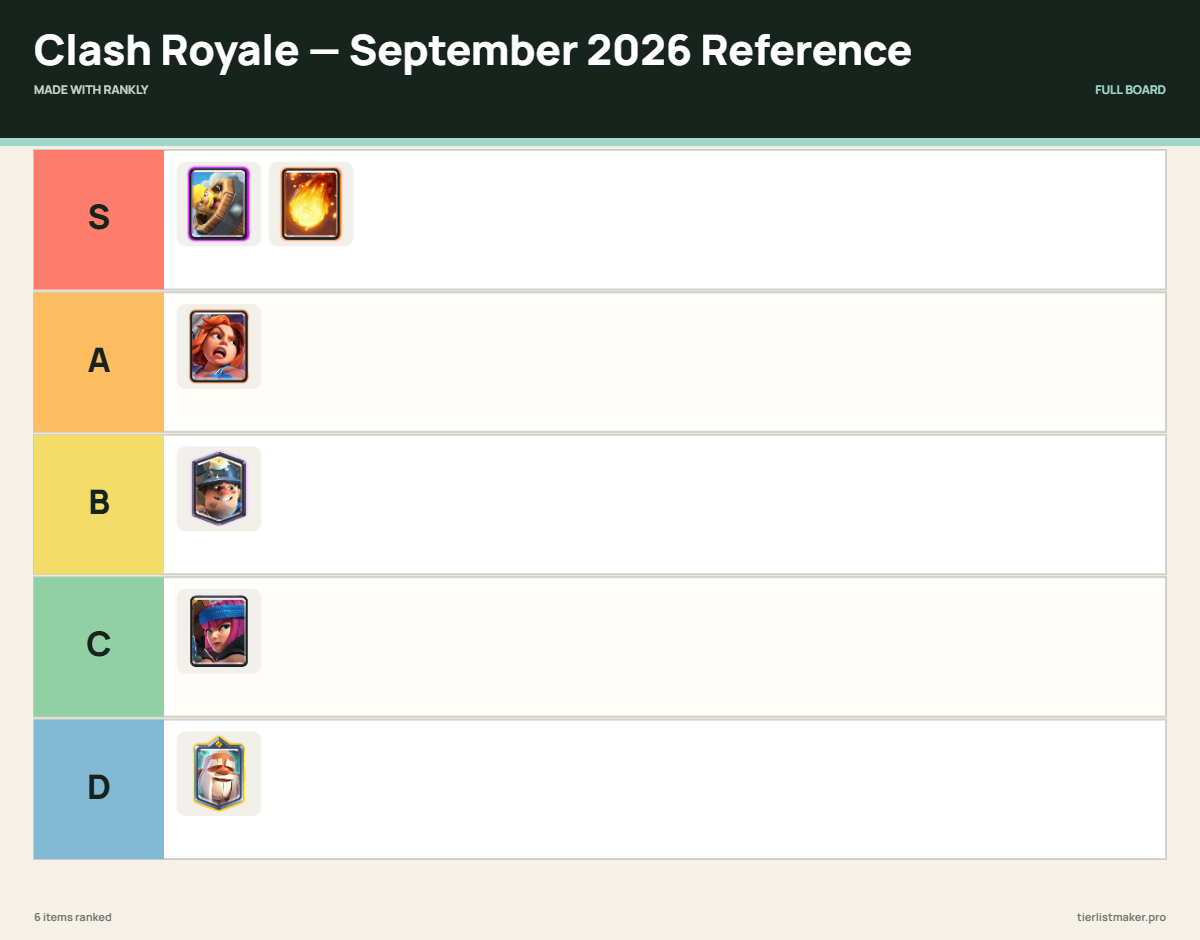
This board was exported from the Rankly editor using the supplied Clash Royale card library. It is an illustrative personal ranking, not a second source of meta data: the example places Barbarian Barrel and Fireball in S, Valkyrie in A, Miner in B, Firecracker in C, and Monk in D.
How to read the current card rankings
Start by asking what job your deck needs. If you need a win condition, compare pressure tools with your average elixir cost and support package. If you need cheap defense, look at how a card changes your cycle and defensive pattern. If you need spell coverage, compare damage, reset, knockback, and swarm answers instead of choosing only by letter grade.
- Choose a role: win condition, defense, cycle, spell, support, or building.
- Check the deck shell: a strong card may become awkward when it competes for the same slot or elixir plan.
- Test the matchup: place the card in your own list and watch whether it solves the problems you actually face.
The A and B groups are often where personal testing becomes most valuable. Valkyrie, Royal Ghost, Balloon, Ice Golem, Inferno Dragon, Lightning, Mortar, Graveyard, and Royal Hogs are in the A group of this snapshot, but their performance still depends on the rest of the deck. A B-tier card can be the correct choice when it provides the exact answer your list is missing.
Why your own Clash Royale tier list may differ
Tier lists compress several questions into one label. “Best in the current meta,” “best for my ladder deck,” “easiest to play,” “best in 2v2,” and “most fun” are all valid criteria, but they produce different rankings.
- The game mode, trophy range, and matchups you see.
- Your deck’s win condition and average elixir cost.
- How consistently you can use a card’s timing or placement.
- A balance patch that has not appeared in an older snapshot.
- Whether you are judging individual cards or complete deck packages.
Give your list a date and a one-line rule. “My ladder ranking after the September 2026 balance changes” tells readers much more than “best cards.” It also makes the board easier to update when the next patch changes the conversation.
How to make a Clash Royale tier list with Rankly
Use the Clash Royale tier list maker to turn your criteria into a shareable board. The editor starts with 122 supplied Clash Royale card images, including the roster represented by the reference above.
- Search the card library or use the card-type filters.
- Drag cards into S, A, B, C, or D. Add an F row if you want to mirror the full Noff scale.
- Rename the board with your mode, date, or ranking rule.
- Upload your own evolution artwork or another variant when you want it as a separate entry.
- Save and share the list, or download it as a PNG for Reddit, Discord, a clan chat, or a video thumbnail.
Place obvious anchors first: cards you would always include, cards you never want to face, and cards whose role is easy to explain. Then compare uncertain cards with an existing anchor instead of restarting the whole board. Within a tier, use left-to-right order to show a preference without creating another level.
Evolution and champion rankings need extra context
Base-card rankings and evolution rankings should not be silently mixed. The linked Noff snapshot provides base-card groups; it does not provide a separate, verified Evo list in the same format. If you rank Evo Firecracker, Evo Knight, Evo Archers, or Evo Tesla, label the patch and rules you used, and keep each variant distinct from its base card.
Champions also need a deck-slot explanation. The reference places Goblinstein in A; Golden Knight and Archer Queen in B; Mighty Miner, Spirit Empress, and Boss Bandit in C; and Monk, Skeleton King, and Little Prince in D or F. Those placements are a starting point, but the champion slot, ability timing, and deck plan can matter more than a single letter.
Build your Clash Royale ranking
Start with the supplied card library, set your own criteria, and export a list you can explain and share.
Open the Clash Royale tier list maker →Clash Royale tier list FAQ
What are the best cards in Clash Royale right now?
In the linked Noff snapshot, the S group begins with Barbarian Barrel, Skeletons, Fireball, Tornado, The Log, Zap, Cannon, Ice Spirit, Hog Rider, and Baby Dragon. Treat that as dated player-data context, not an official universal answer.
How do I make a Clash Royale tier list?
Open the free Clash Royale tier list maker, search or upload images, drag cards into tiers, customize the labels, and export the result as a PNG. No sign-up is required.
Which Clash Royale evolutions are the best?
There is no single answer without naming the patch, mode, deck, and ranking method. The linked reference ranks base cards rather than separate evolution variants, so create an Evo section with its own dated rule.
Are these official Supercell rankings?
No. The rankings are a readable rendering of the linked Noff reference. Balance changes, player samples, deck synergy, and individual skill can all change the result.
Can I add champions or evolution cards?
Yes. The 122-card starter library includes the supplied champion card images. Use the upload control to add an evolution image or any card variant that is not part of the starter set.
Ranking source: Noff Clash Royale Tier List, September 2026 Meta view based on top-250 player data. Noff does not state a patch number on the reference page. Rankly is not affiliated with Noff or Supercell.