
If you are searching for an HSR tier list, the useful answer is a dated reference plus the conditions behind it. A character can be excellent in one endgame mode and awkward in another, while a lower-rarity support can be the missing piece in an account that already owns a carry.
This is a dated third-party endgame reference, not an official HoYoverse ranking. Same-tier order is not an exact score, and placements can change with teams, modes, investment, and new patches.
What this HSR tier list measures
This page is a readable snapshot of the linked HSR Tier List 4.5 reference, updated August 29, 2026. It covers 91 characters across Memory of Chaos, Pure Fiction, Apocalyptic Shadow, and Anomaly Arbitration. The source states an E0 comparison with farmable relics and no signature Light Cone required. Those assumptions make the list easier to compare, but they do not turn a tier label into a pull command.
HoYoverse's official Version 4.5 update details set the update window from August 26 to September 28, 2026, UTC+8. That date is why this article keeps the version and source date visible: an HSR tier list can age as soon as a new kit, balance change, or endgame cycle changes the teams people build.
HSR SS/S+/S/A/B/C tier snapshot
The cards below include all 91 characters in the source grouping. Names such as Himeko and Himeko • Nova, or Silver Wolf and Silver Wolf LV.999, remain separate because the reference treats them as separate entries.
SS Tier
17 charactersThe reference's highest group across its endgame snapshot; placements still depend on team access, mode, and investment.
- Evanescia
- Silver Wolf LV.999
- Himeko • Nova
- Castorice
- Mortenax Blade
- Robin • Summeretto
- Rin Tohsaka
- Sparxie
- Archer
- Ashveil
- Yao Guang
- Cyrene
- Sparkle
- Evernight
- Dan Heng • Permansor Terrae
- Hyacine
- Huohuo
S+ Tier
18 charactersThe next group of high-impact characters in the reference; strong performance does not make every one a universal pull.
- Phainon
- Anaxa
- Sunday
- Tribbie
- Gilgamesh
- Trailblazer (Elation)
- Firefly
- Acheron
- Saber
- Cipher
- Cerydra
- The Dahlia
- Trailblazer (Ice)
- Fugue
- Hysilens
- Kafka
- Black Swan
- Lingsha
S Tier
26 charactersReliable reference placements with useful roles, but the best fit can change between damage profiles and team shells.
- Feixiao
- Mydei
- Ruan Mei
- Robin
- Aglaea
- The Herta
- Welt
- Seele
- Rappa
- Bronya
- Aventurine
- Gallagher
- Jingliu
- Blade
- Boothill
- Silver Wolf
- Tingyun
- Jing Yuan
- Topaz
- Jiaoqiu
- Fu Xuan
- Pela
- Luocha
- Trailblazer (Imaginary)
- March 7th (Imaginary)
- Moze
A Tier
15 charactersGood options whose value is more dependent on a specific team, mode, or account state than the groups above.
- Dr. Ratio
- Imbibitor Lunae
- Himeko
- Argenti
- Clara
- Yunli
- Jade
- Asta
- Gepard
- Bailu
- Herta
- Guinaifen
- Lynx
- Hanya
- Xueyi
B Tier
13 charactersUsable characters with narrower or more conditional value in this dated reference; a missing role can move one up for your account.
- Natasha
- Qingque
- March 7th
- Trailblazer (Fire)
- Serval
- Hook
- Yanqing
- Yukong
- Misha
- Luka
- Sampo
- Dan Heng
- Sushang
C Tier
2 charactersLow-end placements in this snapshot, not a claim that these characters cannot clear content with the right build.
- Trailblazer
- Arlan
Why the key placements are useful
A full roster tells you where the source put each character. The notes below tell you what to check in a real team: damage loop, role, mode coverage, partner access, and the constraint that can make a high-ranked character awkward for your account.
Evanescia SS tier
Best use: build around the Elation loop when you want the snapshot's top-end damage profile across several listed endgame modes. Her value comes from repeatedly converting the kit's energy and stack cycle into damage rather than from one isolated hit. Limitation: an Elation-centered team and the right turn flow matter; a top source placement is not a promise that every account should pull or field her.
Silver Wolf LV.999 SS tier
Best use: treat this as the dedicated Elation main-DPS entry in the reference. The kit rewards spending Skill Points inside a full Elation core, so the team should be built to feed that loop instead of borrowing her as a generic debuffer. Limitation: the value is unusually tied to the Elation plan and resource flow.
Robin • Summeretto SS tier
Best use: place her in teams whose damage comes from frequent ally actions. The source describes her memosprite as charging Vibes from those actions, then opening a Fever window with adaptive support for ATK- and HP-scaling teams. Limitation: the payoff is highest when the team can keep taking meaningful actions; she is not a substitute for a complete damage engine.
Mortenax Blade SS tier
Best use: use the Fire Nihility entry as a debuff-centered enabler when the team wants a zone effect and broad damage support. That makes the character useful beyond a single carry, especially when the rest of the party benefits from enemies staying debuffed. Limitation: the placement describes the reference's broad support value, not a guaranteed best partner for every DPS.
Himeko • Nova SS tier
Best use: build around the Fire Erudition mech and its Assist Skill when your team can make the Trailblaze Companion interaction matter. This is a different job from the older Himeko entry: keep the two names separate when making your own board. Limitation: the new form's value depends on the accompanying mechanics, so do not merge them into one generic Himeko score.
Castorice SS tier
Best use: use the source's SS placement as an endgame reference point when comparing current high-investment damage teams. Evaluate her beside the sustain and support pieces your account can actually provide. Limitation: a tier label compresses team requirements, mode fit, and investment into one mark, so it cannot answer a pull decision on its own.
Firefly S+ tier
Best use: put her in a Super Break shell with the support pattern named by the reference—Fugue and Ruan Mei are natural partners, with Gallagher covering sustain and break-oriented utility. Limitation: the team must reliably create and extend break windows; outside that plan, her tier is less informative than the build's actual break access.
Acheron S+ tier
Best use: judge her as a debuff-fed damage carry. The team should be able to apply enough meaningful debuffs to keep her ultimate cycle moving, rather than treating the tier label as raw personal damage. Limitation: partner quality and debuff timing can change the result more than a one-letter difference.
Sunday S+ tier
Best use: compare him with teams that gain value from turn manipulation and concentrated support on one carry. He is most useful when the team can convert those extra actions into a real damage or summon cycle. Limitation: a support can look weaker when the roster has no carry whose action economy it can exploit.
Feixiao S tier
Best use: build a follow-up attack shell and let frequent allied actions feed the team's pressure. Robin, Topaz, and Aventurine are sensible comparison partners for this archetype, but the article treats that as a team pattern, not a universal prescription. Limitation: her ranking falls in practical value if the rest of the party cannot supply enough follow-up activity.
Gallagher S tier
Best use: use the 4-star sustain when a break-oriented or resource-conscious account needs healing without giving up the rest of its team plan. He is also one of the source's higher-ranked accessible options. Limitation: a lower rarity does not make him best in every mode, and his value still depends on the team's damage and break rhythm.
Pela S tier
Best use: choose her when straightforward debuff utility and low-cost support are more valuable than another damage dealer. She is a practical comparison point for accounts that need to improve a carry's target damage with a simple support slot. Limitation: her ranking does not remove the need for sustain or for a team that can capitalize on the debuff.
A real Rankly export example
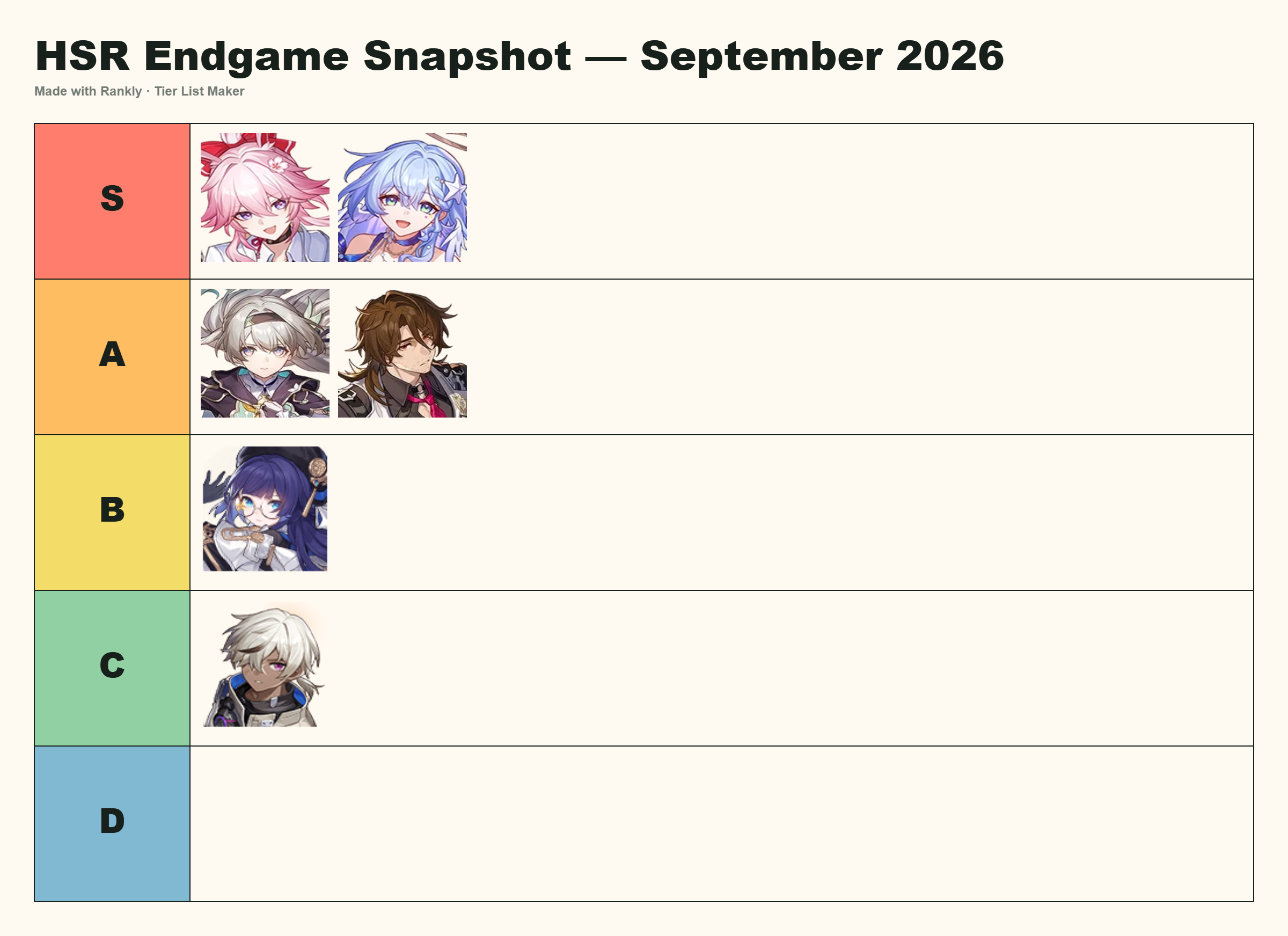
This board was exported from the Rankly HSR editor using the supplied character image library. It is a personal example, not a second meta source: the placements demonstrate how to compare an Elation carry, a follow-up support, a break DPS, a sustain option, and a flexible debuffer inside one readable board.
How to choose a character for your account
Start with the job your second team cannot currently do. A high-ranked damage dealer is not automatically better than a support who completes an existing archetype, and a sustain unit can be the difference between a theoretical rotation and a clear. Use the source as a shortlist, then test each candidate against the account you actually have.
- Name the mode: decide whether the list is for Memory of Chaos, Pure Fiction, Apocalyptic Shadow, Anomaly Arbitration, or broad endgame coverage.
- Name the job: carry, breaker, follow-up enabler, debuffer, buffer, summon support, or sustain.
- Check the partners: ask whether the support, speed, debuff, break, or action pattern that makes the character good is available to you.
- Check the cost: compare relic quality, light cone access, skill point pressure, and whether the rotation still works at E0.
Accessible options deserve their own question
The reference places Trailblazer (Elation) in S+, Gallagher, Tingyun, Pela, and March 7th (Imaginary) in S, and Trailblazer (Imaginary) in S. That does not mean every free or four-star option is universally stronger than a five-star. It does mean an account can build a useful team around accessible roles instead of reading the top of the list as the only path to progress.
How the four endgame modes change the answer
Do not compare a wave-clear specialist and a single-target specialist as if they were solving the same fight. Pure Fiction can reward a different damage loop from a boss-focused stage; Memory of Chaos and Apocalyptic Shadow can ask different questions of speed, break, sustain, or target priority; Anomaly Arbitration adds another context to the source's broad endgame view. The correct personal list can therefore use columns or separate boards rather than one forced order.
When a new cycle starts, record the date and the source cycle beside your placements. If only one mode changes, update that mode's notes instead of rewriting every character as if their kit changed overnight.
Why your own HSR list may differ
A tier list compresses several decisions into a letter. Your result can differ because your account lacks a partner, because you value low-investment clears, because you care about one mode, or because you rank ease of play instead of maximum ceiling. Those are not errors when the rule is explicit.
- Separate “best in this source snapshot” from “best for my account.”
- Keep alternate forms and distinct source entries separate when the kit or role differs.
- Use left-to-right order inside a tier for preference, but do not pretend it is a precise score.
- Record the patch, source date, Eidolon assumption, and Light Cone assumption with the board.
How to make an HSR tier list with Rankly
Use the Honkai: Star Rail tier list maker to turn your rule into a board. The editor starts with the supplied HSR character images and lets you search by name, filter by element or rarity, move cards into tiers, rename rows, and download a PNG.
- Write the rule in the title, such as “My E0 Pure Fiction ranking — September 2026.”
- Place clear anchors first: the characters you would build around, the sustain you trust, and the support your account can actually pair.
- Move uncertain entries only after comparing them with an anchor in the same role.
- Export the board, then keep the source date in the caption or post that accompanies it.
For a personal board, S/A/B/C/D is fine when you define each tier. For a source reproduction, keep SS/S+/S/A/B/C so readers can distinguish your opinion from the reference.
Build your own Honkai: Star Rail tier list
Start with the supplied HSR character library, define the mode or account rule, and export a board that explains your own ranking.
Honkai: Star Rail tier list maker →Honkai: Star Rail tier list FAQ
What is the best character in Honkai: Star Rail right now?
In the dated 4.5 reference used here, Evanescia, Silver Wolf LV.999, Himeko • Nova, Castorice, Mortenax Blade, Robin • Summeretto, and the other SS entries form the top group. That is source context, not an official universal answer; team access, mode, investment, and future patches can change the result.
How is this HSR tier list ranked?
It renders the linked third-party endgame reference, which covers Memory of Chaos, Pure Fiction, Apocalyptic Shadow, and Anomaly Arbitration under an E0 and farmable-relic assumption. It does not claim to be an official HoYoverse ranking or a personal account recommendation.
Why can two HSR tier lists disagree?
They may use different endgame modes, cycles, investment levels, signature Light Cone assumptions, team access, or standards for judging a support. Always compare the date and method before comparing the letters.
Does an SS placement mean I need a signature Light Cone?
No. The reference rendered here states an E0 assumption with farmable relics and no signature Light Cone required. That makes the snapshot easier to compare, but it does not remove the value of a character's team, relic, speed, or rotation requirements.
How do I make my own HSR tier list?
Open Honkai: Star Rail tier list maker, choose whether you are judging endgame coverage, ease of use, account value, or another rule, then drag characters into your own tiers and export the board. Keep the date and standard in the title so the list remains understandable after the next patch.
Ranking source: HSR Tier List 4.5, updated August 29, 2026. Official version context: HoYoLAB Version 4.5 Update Details. Rankly is not affiliated with HoYoverse or the third-party source.